

If a piece of content succeeds but the team cannot explain why, the next attempt still starts from zero. That success was closer to luck than capability. Likewise, if an account keeps gaining views without improving retention, product use, or revenue, much of that traffic may simply be passing through.
1. Productization: Make Success Less Dependent on One Person
The recurring problem in content teams is often not a lack of ideas. It is that experience cannot be reproduced. One editor knows which titles earn clicks, an operator knows when to publish, and a salesperson knows which cases matter to buyers. When that knowledge lives only in individual heads, a personnel change forces the team to learn the same lessons again.
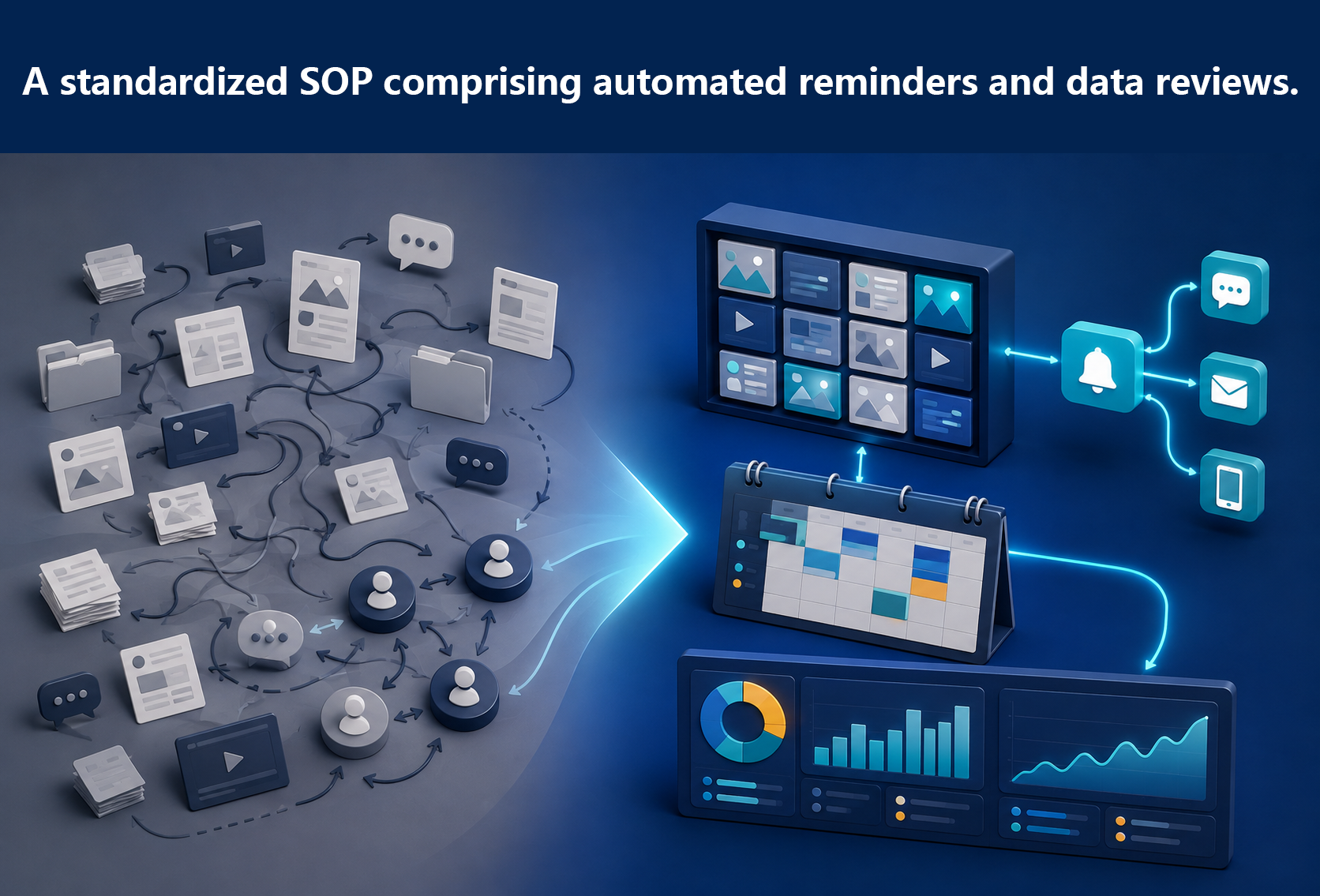
Productization turns personal experience into organizational capability. It has two layers. The first is process productization. Imagine a team that publishes 20 pieces a week: topics are proposed in chat, assets sit in scattered folders, reviews depend on reminders, and results are never logged consistently. People work hard, but much of their time goes into searching, confirming, and waiting.
A shared content board can connect each topic to a user need, owner, production stage, channel, and measurement plan. Its value is not a prettier spreadsheet. It is lower coordination cost and fewer avoidable mistakes.

The second layer is productizing outcomes. A design-tool site may find that trend articles attract more visits, practical tutorials send more readers into the product, and template collections generate fewer visits but more saves and return sessions. The useful lesson is not merely “what goes viral.” It is the role each content type plays:
- Trend content attracts new audiences.
- Tutorials activate a need.
- Templates support retention.
- Case studies support conversion.
Each type needs its own structure, entry point, and success measure. The Lean Startup describes a Build–Measure–Learn loop. In content work, that means validating a topic at low cost and expanding only after real feedback. Productization does not remove creativity; it fixes the parts already proven so judgment can be spent where it matters.
2. ROI Thinking: Views Are Not the Outcome; Changed Behavior Is
ROI is often reduced to money spent versus money returned. Content returns may first appear as registrations, search visibility, brand trust, leads, or retention. The first question should therefore be not “How many views did this get?” but “What should readers do after reading it?”
Consider an illustrative SaaS example. An industry-trend article receives 100,000 views and 20 trial requests; a problem-solving article receives 8,000 views and 100 trial requests. The first may be better for broad awareness, while the second is far more efficient for acquisition. Traffic without a business objective easily turns a vanity metric into a management target.
Lean Analytics calls for focusing on the metric that matters most at the current stage—the One Metric That Matters. Acquisition content can prioritize new users and organic entrances; activation content, tool use or registration; retention content, revisits, saves, and subscriptions; conversion content, inquiries, trials, and sales; brand content, branded search, direct traffic, and long-term recall.
ROI also means opportunity cost. Three days spent chasing a trend are three days not spent improving a tutorial, core landing page, or evergreen resource. Giving a prominent placement to a low-click campaign also removes that opportunity from a better-matched item.
A useful review asks: Would we invest the same resources again? Which step limited the result? Is there a less expensive route? The exposure → conversion → retention → revenue chain forces the team to see how traffic enters, where it leaks, and what remains—not only how large the view count looks.

3. Monetization: Complete an Exchange of Value, Not Just Add Ads
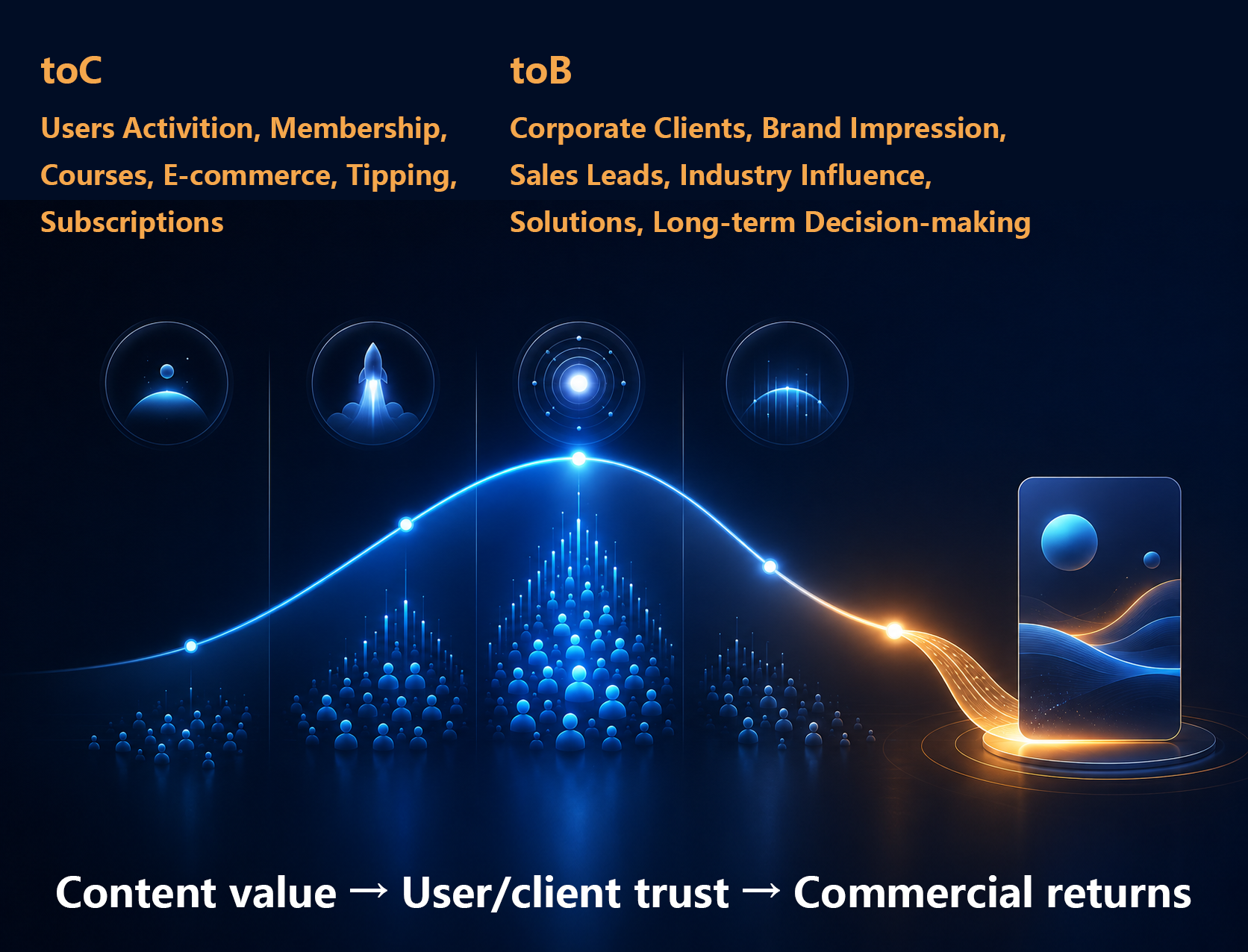
Monetization is often mistaken for “starting to sell.” Its real prerequisite is that content solves a sufficiently clear problem for a defined audience. Two common paths are B2C and B2B.
B2C: People Pay for an Outcome, Efficiency, or Experience
Individuals rarely pay because content was expensive to produce. They pay for what it helps them achieve. A font-tool site might attract users with a guide to social-profile layout, then offer copy-ready text styles, emoji combinations, and templates. Free content frames the problem; the tool completes the task; premium templates or membership save additional time.
The path is: expression problem → search → understanding a solution → using the tool → getting a result → paying or returning. Knowledge products work similarly. The strongest paid value is often not “more information” but an organized path, feedback, practice, and fewer costly mistakes. B2C operators therefore need to observe what happens after consumption: Did the reader use the product, return, and form a habit?
B2B: Help an Organization Reduce Decision Risk
B2B content serves an organization, not just a reader. Finding an article useful does not create a purchase by itself; budget, compliance, technology, security, and internal agreement also matter. B2B content must therefore educate a buying process as well as read well.
A “2026 Guide to Cross-Cultural Communication” may generate attention as general education. Add industry risks, the cost of errors, implementation steps, customer evidence, and a checklist, and it can help a buyer decide whether the problem deserves action. Industry reports establish the issue; methodology demonstrates expertise; case studies reduce risk; white papers capture leads; product documentation supports trials and delivery.
B2C tends toward frequent, lower-value, shorter journeys. B2B tends toward infrequent, higher-value, longer trust-building journeys. Monetization is not the end of growth either. Reforge’s growth-loop model reinvests the users, data, word of mouth, and new material generated by one cycle into the next.
4. Put the Three Ideas Into One Operating Loop
- Productization asks how value can be produced more reliably.
- ROI asks where limited resources should go first.
- Monetization asks how user value becomes revenue that can fund the next cycle.
Content should not be a disposable output. It can become an asset that keeps acquiring users, validating demand, and generating value. Junior operators complete tasks, mid-level operators optimize metrics, and senior operators design systems.
Conclusion: The Destination Is a Sustainable Business Loop
Operational maturity is not simply publishing regularly or producing a hit. The real questions are whether content changes user behavior, whether that behavior creates business value, and whether the value can support another round of investment. Four questions make this practical.
Question 1: Which Business Problem Does This Content Serve?
Start from the business constraint, not “What should we publish this week?” If acquisition is weak, content may need to capture search demand or widen distribution. If new users do not understand the product, it should educate and activate. If they leave after one use, it should expand use cases and habits. If buyers delay, it should address trust, risk, and decision evidence.
A BioFontsApp guide to cross-cultural emoji communication can capture relevant search demand, show readers why emoji choice carries contextual risk, and lead that need into an emoji search-and-copy tool. Success then includes organic entrances, tool clicks, and subsequent returns—not views alone. Strategyzer’s value-proposition approach makes the same move: identify customer jobs, obstacles, and desired outcomes before designing the solution.
Question 2: What Observable Change Should the User Make?
“Increase awareness” is difficult to operate. Should the reader continue reading, save the page, search for the brand, use a tool, register, request a trial, or forward the article to a decision-maker? Translating goals into behavior lets the team design a path and locate the point of failure.
A font-trend article may bring high traffic but little tool use, suggesting broad interest. An Instagram bio-font tutorial may bring fewer visitors but a high tool-click rate, suggesting a concrete use case. Neither is inherently better; each should be judged by its assigned job. The One Metric That Matters prevents surface numbers from steering every decision.
Question 3: What Reusable Asset Did This Investment Leave Behind?
Current returns include reach, registrations, inquiries, and revenue. Asset returns include keyword rankings, audience data, reusable templates, topic insight, distribution channels, cases, and trust. A topical post may fade in days, while a tutorial that solves recurring demand may attract search users for years.
A review should ask what demand was validated, which title or channel can be reused, whether the work can become video, social, email, or sales material, whether it strengthens a topic cluster, and whether the data can guide product or editorial decisions. If an investment produces neither a business result nor a learning asset, stopping is reasonable. If it produces stable value, template it, support it with tools, and scale it.
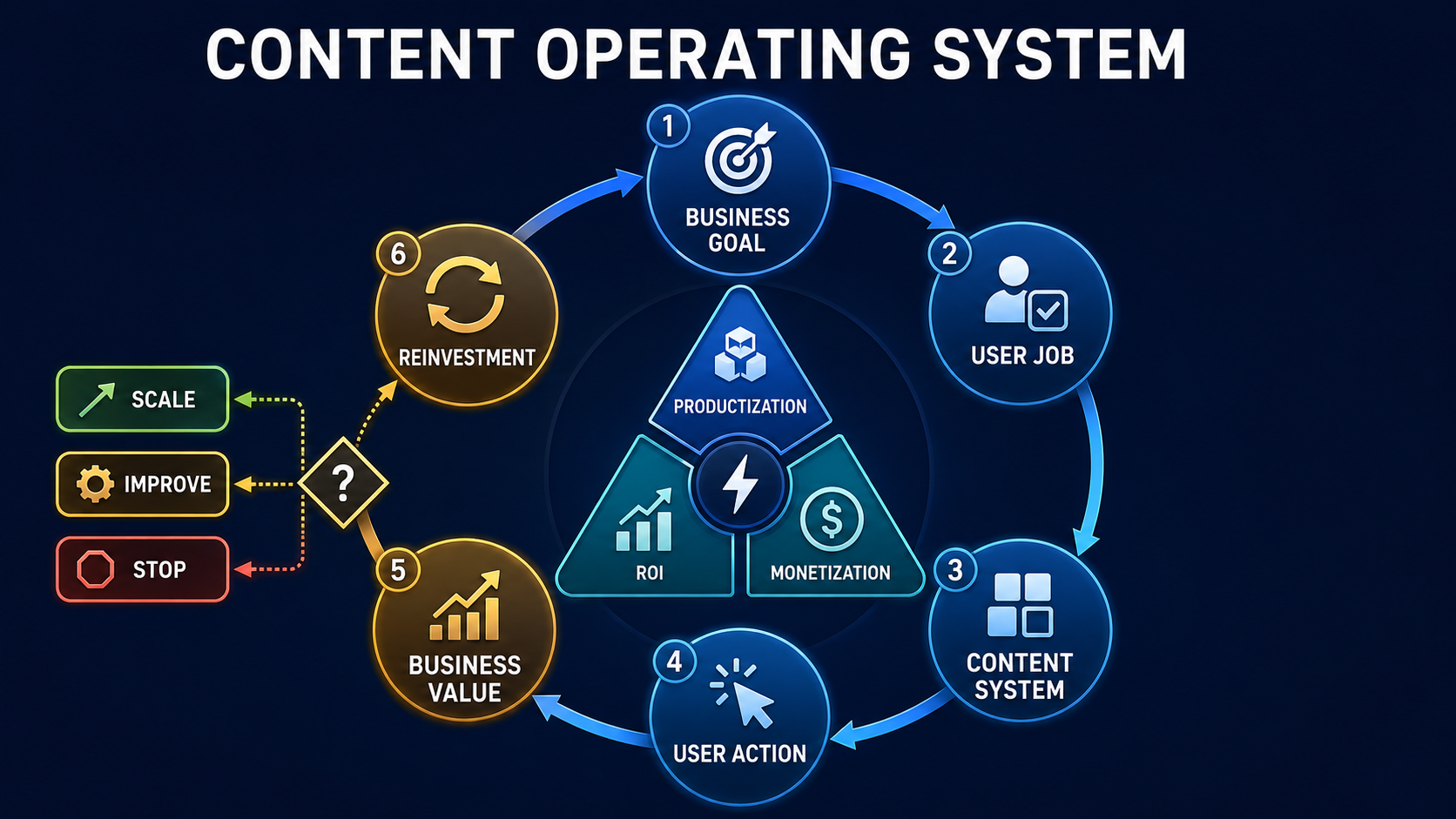
Question 4: Should the Next Round Scale, Improve, or Stop?
The purpose of review is to change resource allocation:
- Scale: Demand and the conversion path are validated; add production, distribution, or product support.
- Improve: Demand exists, but a clear step leaks; test the title, structure, audience source, or landing page.
- Stop: The work repeatedly attracts no useful users and creates no strategic asset.
A tutorial series that consistently brings search users into the tool should become a topic cluster. Trend posts with views but little downstream behavior may receive less investment while retaining a small awareness role. A low-download enterprise paper that creates several high-quality sales leads should not be cut solely for low traffic. Harvard Business Publishing’s introduction to customer lifetime value likewise connects scarce marketing resources to the expected value of different customer groups.
From One Article to a Growth System
Business problem → user job → content solution → user behavior → business result → accumulated asset → resource reallocation.
Productization makes proven methods reusable. ROI discipline directs resources. Monetization converts user value into revenue and budget. When revenue, data, and learning feed the next cycle, growth becomes an operating loop rather than a one-time funnel. Reforge similarly connects retention, monetization, and growth.
The goal is not an ever-fuller publishing calendar. It is a decision system that explains what to keep producing, what to productize, what builds customer relationships, what earns revenue, and whether those returns can support the next round of growth.
References
- Nalan Feifei, “The Underlying Logic of Content Operations: Productization”
- Nalan Feifei, “The Underlying Logic of Content Operations: ROI Thinking”
- Nalan Feifei, “A First Lesson in Content Operations for New Operators”
- Eric Ries, The Lean Startup
- Alistair Croll and Benjamin Yoskovitz, Lean Analytics
- Alexander Osterwalder et al., Value Proposition Design
- Sean Ellis and Morgan Brown, Hacking Growth
- Nir Eyal and Ryan Hoover, Hooked
- Reforge, “Growth Loops Are the New Funnels”
- Reforge, “Monetization vs Growth? It’s a False Choice”
- Harvard Business Publishing, *A Conceptual Introduction to Customer Lifetime Value*