
1. Why emoji are a risk variable in global marketing
Face-to-face communication gives us tone of voice, expression, gesture, and distance. Digital messages strip many of those cues away, so emoji are used to add emotion, soften language, express brand personality, and make a message feel more human. They are inexpensive, easy to notice, and useful when space is tight.
The same qualities also create room for misreading. An emoji does not carry one stable meaning outside its context. Cultural norms, language, age, community identity, platform, device, and the relationship between sender and recipient can all change the reading. A systematic review by Bai and colleagues found that emoji support emotional expression, semantic detail, and interpersonal interaction, while comprehension varies with cultural, individual, and technical factors[1]. Unicode standardizes encoding and a general appearance; it does not assign one social meaning to every symbol[2].
2. How emoji acquire meaning: from code point to context
2.1 Unicode encoding is not social meaning
Unicode answers how a symbol is represented and transmitted, not how a person will interpret it. One code point may look different across operating systems, and the same drawing can serve different purposes in different communities. 💀 may signal death or danger in a formal message, yet mean “I’m dying laughing,” shock, or secondhand embarrassment in some younger communities. Neither reading is inherently wrong; context and group norms select the likely one.
2.2 Emoji perform several pragmatic jobs
Emoji can mark emotion, add or organize meaning, and manage a relationship by softening a request or signaling shared humor. Those jobs can shift. 🙂 may read as a polite smile, emotional distance, resignation, or sarcasm. 🙏 can mean prayer, thanks, a request, or good wishes. Repeated 👏 may be applause, emphasis, pressure, or mockery. Reviewers therefore need to ask whether text and symbol agree, whether the symbol carries essential information, whether the audience shares the intended convention, and what a wrong reading would cost.
3. Cultural differences cannot be reduced to a country blacklist
3.1 Culture changes probabilities, not absolute rules
Culture affects how people read color, gesture, facial expression, religious imagery, and body movement. These are usually shifts in tendency and probability, not rules followed by every member of a country. Chen and colleagues found that age, cultural background, and familiarity all affect the classification and comprehension of facial emoji[3]. Cross-language research likewise suggests that some emoji retain a broad semantic core while frequency, combinations, and pragmatic use vary by language[4].
3.2 Give gestures, faces, and religious imagery extra scrutiny
For practical review, this article treats gestures, facial expressions, and religious imagery as priority categories; it does not claim that they are always riskier in every country or campaign. Gestures are tied to etiquette, religion, and history. Small changes to eyes, mouth, color, or intensity can shift a face from sincere to cold, mocking, or threatening. Religious symbols, death, body parts, and illness deserve added care. In health care, insurance, public safety, disaster response, and mourning, emoji should never carry the primary message.
3.3 What can travel, and what needs local validation
Ignoring culture invites mistakes, but treating every country as a sealed set of permanent rules creates stereotypes. Public research and cultural notes are starting points. Teams should combine them with local media observation, real comment analysis, and review by people in the market, recording the source and date. When evidence is weak, use explicit wording or a small test rather than guess.
| Emoji | Possible meanings | Common use | Potential risk | How to validate |
|---|---|---|---|---|
| 🙂 | Gentle smile, polite acknowledgement, neutral reply | Product greetings, customer support, general copy endings | May read as dismissive, distant, or mildly sarcastic rather than simply happy | Check the surrounding copy; pair with clear positive wording; preview with a small target-audience sample |
| 🙏 | Thanks, request, wish, prayer | Thank-you copy, wish-making campaigns, request language | May be read as prayer, pleading, or submission in different contexts | Check context; avoid using it alone; review local audience habits |
| 👏 | Applause, approval, praise, sarcastic emphasis | Celebrating results, praising users, campaign highlights | In a sarcastic context, it may sound mocking rather than celebratory | Review the full sentence; add positive wording; do not isolate it beside contentious content |
| 💀 | Death, horror; online slang for “I’m dying laughing” | Meme-led copy, topical jokes, darker creative styles | Some audiences associate it directly with death or bereavement; it can feel unsuitable in formal brand messaging | Validate the context; generally avoid in formal external copy; use cautiously beyond younger audiences |
| 👍 | Like, approval, agreement; sometimes an insulting gesture | Review prompts, acknowledgement, agreement | In some cultures it may be read as challenging or impolite | Check the target market; do not make it the only signal of intent; state the attitude in words |
| 🔥 | Hot, popular, high-energy; also anger or conflict | Trend promotion, topical content, bestseller claims | It can be read as anger or a conflict event when the context is unclear | Anchor the intended meaning with words such as “popular” or “trending”; avoid pairing it with crisis imagery |
| 🤌 | Fine, precise, “nailed it”; meme expression | Playful “nailed the product / nailed the trend” copy | In some cultural settings it can be read as an offensive hand gesture | Check the destination market; avoid it in B2B or formal external materials |
4. Generational and community differences
4.1 Age is not the only variable
Age often overlaps with platform habits, occupation, education, language, and community participation. Younger users may encounter irony and meme conventions more often, but neither younger nor older audiences are uniform. Audience research should describe actual behavior instead of using birth year as a shortcut.
4.2 Meaning changes over time
Events, memes, and platform culture can change the social meaning of a symbol quickly. A once-neutral emoji may acquire a new implication; a niche reading may move into the mainstream. An internal lexicon needs current examples and a last-reviewed date.
4.3 In-group meaning can become an out-of-group risk
Gaming, fandom, professional, and identity communities may use emoji as shorthand. That can strengthen belonging inside the group but become opaque—or offensive—when a public campaign reaches beyond it. Essential information must remain understandable to outsiders.
5. Platform and device differences: rendering changes tone
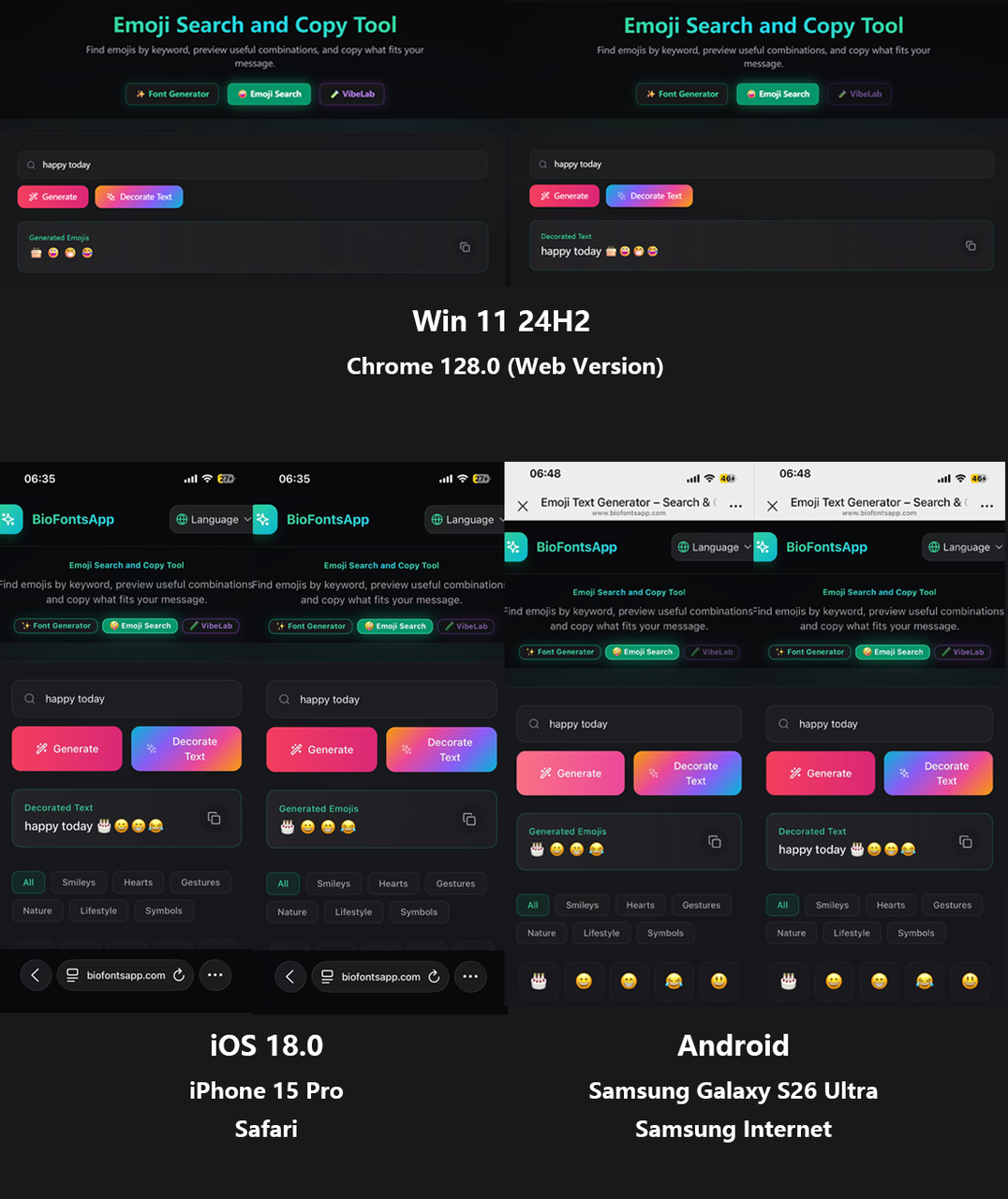
Apple, Google, Microsoft, Samsung, and individual apps draw the same Unicode code point in their own style. Changes in eyes, mouth, color, shadow, or gesture angle can turn warmth into awkwardness or a joke into hostility. Older devices may show a replacement glyph or empty box. Cross-platform review should cover the mobile systems, web experience, and key apps used by the target audience. Payment notices, complaint responses, public apologies, health information, legal statements, and safety alerts should rely on clear text; emoji may support the message but must not carry facts, conditions, timing, or responsibility.
6. A risk framework: ask how risky, not merely whether it is allowed
The levels below are a practical framework derived from the cited research and international marketing workflows. They are not a Unicode standard and do not replace local law, platform policy, or cultural review.
6.1 Low-risk use
The text already states the facts, the emoji is decorative or adds a light emotional cue, the audience relationship is familiar, and a misreading would not create financial, legal, or safety harm. Routine holiday greetings and non-sensitive community interaction often fit here after review.
6.2 Medium-risk use
Cross-cultural ads, first contact with unfamiliar users, customer-service replies, early crisis responses, and negative-emotion content need local review and an emoji-free alternative. Ambiguous wording, apologies, and promises raise the stakes.
6.3 High-risk use
Payment, refunds, contracts, pricing, medicine, public safety, disasters, complaints, legal responsibility, public apologies, and sensitive events require explicit, verifiable language. Reviewers should consider not only the probability of misunderstanding but also its cost: complaints, financial loss, weakened trust, or compliance exposure.
7. A review process brands can use
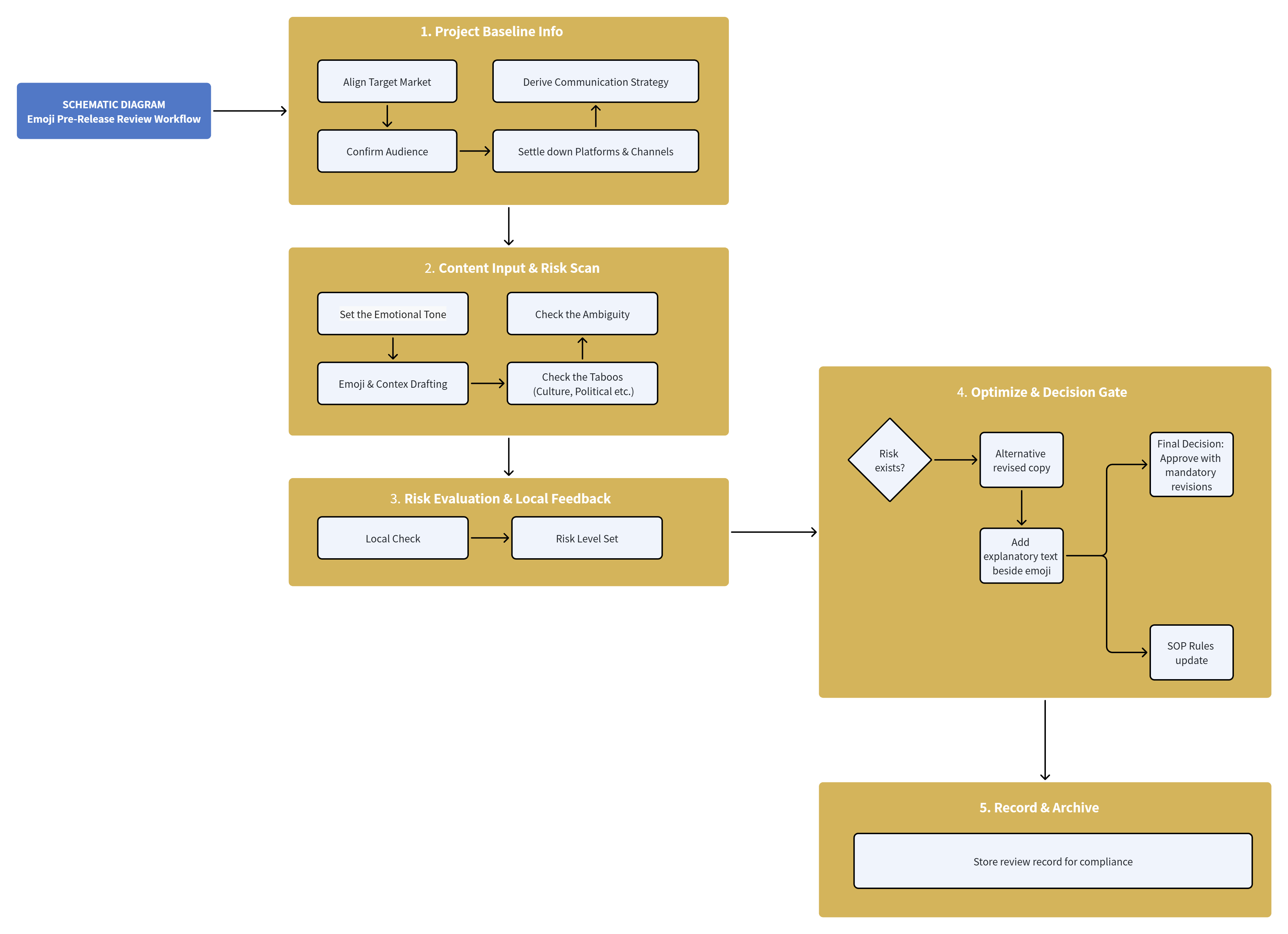
1. Message independence. After removing the emoji, are the facts, time, price, conditions, and required action still complete?
2. Context. In comparable situations in the target market, is the emoji literal, emotional, humorous, or an in-group signal?
3. Audience. Could age, language, or community produce a meaningful ambiguity?
4. Cultural sensitivity. Does it involve gestures, religion, death, illness, bodies, politics, or social conflict?
5. Rendering. Does it display acceptably on iPhone, Android, the web, and the actual placement app?
6. Consequences. What happens if it is read as sarcasm, indifference, offense, or a promise?
7. Local review. When uncertain, involve local staff, a professional translator, or audience representatives; use a limited test where appropriate.
8. Record and learn. Save the symbol, copy, market, platform, review notes, test result, and date, then update the decision with live feedback.
A working emoji lexicon should record markets, common readings, caution or exclusion contexts, alternative copy, rendering differences, risk level, evidence source, and last review date. It is a living knowledge base, not a permanent rulebook.
8. Limits of research and practice
Current studies are often based on surveys, experiments, limited samples, and particular platforms. They may not represent an entire country or age group. Meanings change quickly, and studies do not always define “correct comprehension,” emotional agreement, or usage frequency in the same way. Culture, age, and platform also overlap. Responsible citation therefore states the sample, date, platform, and method. The sound conclusion is not “this emoji always means X in this country,” but “this audience, platform, and context show an elevated probability of this kind of misreading.”
9. Conclusion
Emoji risk comes from a mismatch between intended meaning and communication context. Global brands should neither use them everywhere nor ban them outright. State facts, conditions, and actions in words first; then decide whether the emoji genuinely improves tone, relationship, or comprehension. A durable program observes real language, distinguishes tendencies from absolutes, tests devices and platforms, involves local reviewers, and keeps an auditable record. That is how emoji become a bounded, evidence-supported communication tool instead of an avoidable liability.
References
[1] Bai et al. (2019), A Systematic Review of Emoji.
[2] Unicode Consortium, FAQ—Emoji and Pictographs.
[3] Chen et al. (2024), Individual differences in emoji comprehension.
[4] Barbieri et al. (2016), How Cosmopolitan Are Emojis?
[5] Miller et al. (2016), Varying interpretations of emoji.
[6] Huang Yuxuan (2025), A review of emoji as emotional symbols in verbal communication.